


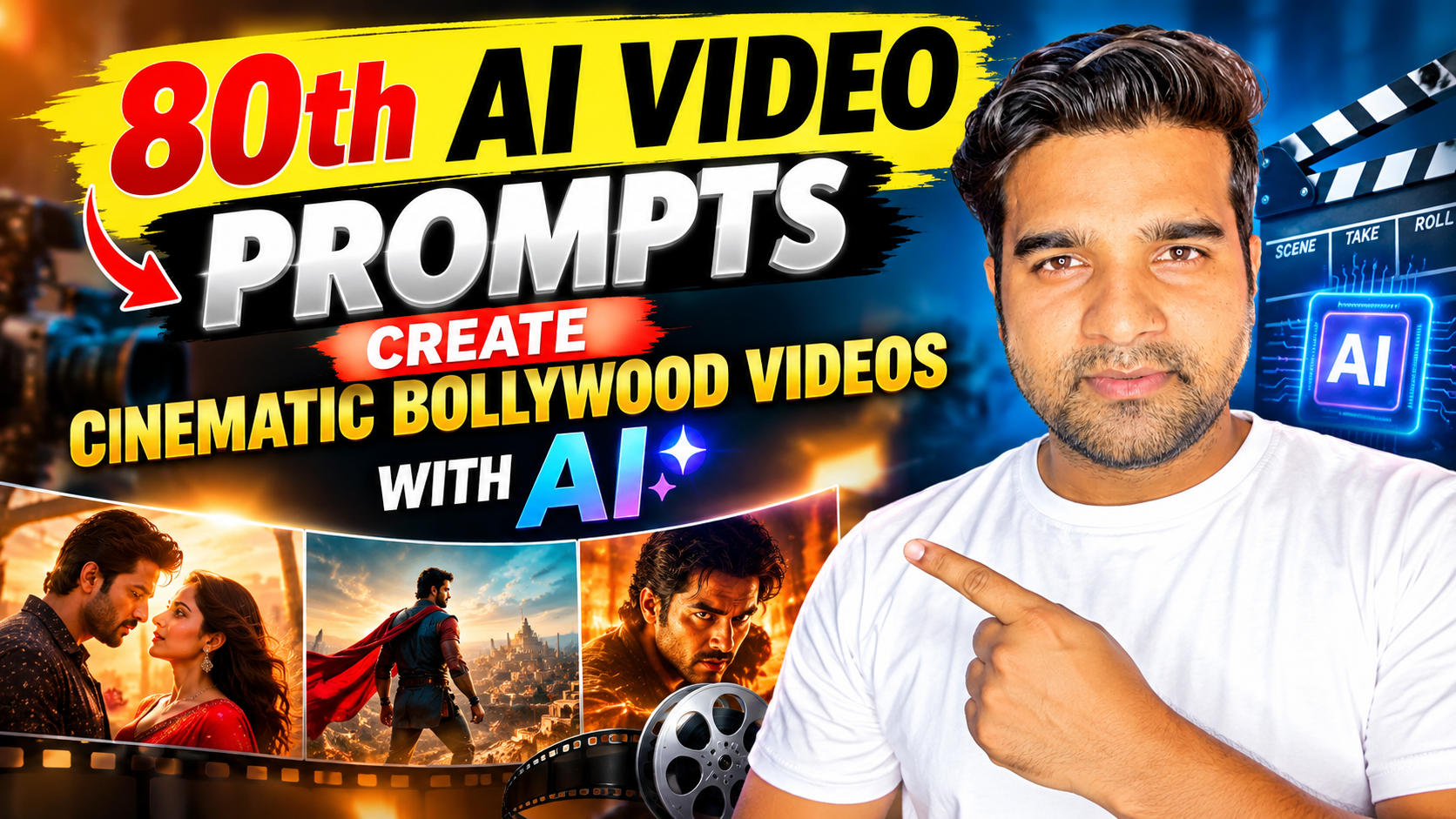
Want to turn your normal photo into an authentic 1980s Bollywood-style cinematic video using AI?
In this guide, I am sharing a powerful 80s AI Video Prompts workflow that can help you create a complete cinematic scene from your character photo.
The interesting part is that you don’t directly convert your photo into a random video. First, you create a 3×3 cinematic storyboard containing 9 continuous frames, and then use that storyboard as the visual blueprint to generate the final video.
This method is especially useful for creating romantic, action, comedy, emotional, dramatic and retro Bollywood-style AI videos.
Note: Availability of free AI features can vary depending on your account, region and current offers. Always check the current availability of the tools you are using.
How This 80s AI Video Method Works
The workflow is simple:
Your Photo → AI Storyboard → 9 Cinematic Frames → Google Gemini → 10-Second Video
Instead of asking an AI video generator to randomly animate your photograph, the storyboard gives the AI a clear sequence of what should happen.
This helps create better character consistency, camera movement, lighting and scene continuity.
Step 1: Upload Your Character Photo
First, choose a clear photograph of yourself.
For a romantic scene, you can provide:
- Hero reference image
- Heroine reference image
- Optional wardrobe reference
The AI should use these images as the primary identity references.
Make sure the face is clearly visible because the better the reference image, the easier it is for the AI to maintain visual consistency.
Step 2: Create a 3×3 Cinematic Storyboard
Now copy the following 80s AI Video Prompt into your AI image generation tool.
Before generating it, select the type of scene you want, such as:
Romantic / Action / Fight / Comedy / Sad / Dramatic / Hero Introduction / Heroine Introduction / Friendship / Celebration
Prompt 1 — Create the 1980s Cinematic Storyboard
Create ONE single 3×3 cinematic storyboard sheet containing EXACTLY 9 individual storyboard frames for a 10-second photorealistic vertical 9:16 video.

I will provide one or more character reference images.

HERO REFERENCE IMAGE: [UPLOAD HERO IMAGE]
HEROINE REFERENCE IMAGE: [UPLOAD HEROINE IMAGE]

SELECTED SCENE TYPE: [ROMANTIC]

Generate the entire 9-frame storyboard ONLY according to the selected scene type.

For a ROMANTIC scene, every frame should support innocent attraction, eye contact, subtle smiles, shy reactions, longing and emotional connection.

Create ONE simple continuous 10-second scene inspired by authentic late-1970s to mid-1980s Indian Bollywood cinema.

The 9 panels must represent approximately 9 consecutive visual beats from the same scene.

01 — 0:00–0:01
02 — 0:01–0:02
03 — 0:02–0:03
04 — 0:03–0:04
05 — 0:04–0:05
06 — 0:05–0:06
07 — 0:06–0:07
08 — 0:07–0:08.5
09 — 0:08.5–0:10

Each panel must contain:
• Cinematic storyboard image
• Panel number
• Timecode
• Very short shot description

The 9 panels must look like consecutive moments from ONE continuous scene.

Use professional cinematic compositions such as:
wide shot,
medium shot,
close-up,
extreme close-up,
over-the-shoulder,
profile,
two-shot,
low-angle shot,
slow dolly-in,
tracking shot,
rack focus and controlled camera movement.

Maintain the exact identity of the uploaded characters throughout all panels.

Preserve:
face,
eyes,
nose,
lips,
jawline,
skin tone,
hair,
beard,
age,
body proportions and recognizable appearance.

Do not replace the characters with generic actors.

Use an authentic 1980s Indian Bollywood visual style:
35mm film photography,
warm golden sunlight,
slightly faded analog colors,
natural film grain,
soft film halation,
realistic skin texture,
natural optical softness,
shallow depth of field,
real optical bokeh,
subtle lens flare,
natural motion blur,
warm amber highlights,
earthy shadows and atmospheric haze.

Do NOT simply apply a retro filter.

The environment should look genuinely like 1980s India.

Use authentic period details such as:
vintage cars,
old scooters,
bicycles,
old college buildings,
railway stations,
roadside chai stalls,
old markets,
period posters,
books,
newspapers and vintage furniture.

Do NOT include:
smartphones,
modern cars,
LED advertisements,
modern buildings,
modern clothing or contemporary objects.

Maintain complete continuity across all 9 frames.

Keep the same:
characters,
faces,
hairstyles,
wardrobe,
location,
props,
lighting,
weather,
time of day,
camera direction and film look.

For a romantic scene, use innocent classic Bollywood romance.

Possible progression:

01 — Hero notices heroine.
02 — Heroine notices him.
03 — Hero looks toward her.
04 — Heroine holds eye contact.
05 — Heroine becomes shy.
06 — She looks away.
07 — Hero gives a subtle smile.
08 — She looks back.
09 — Final lingering eye contact.

Create ONE polished 3×3 storyboard contact sheet with exactly 9 panels.

The final storyboard should look like a professional cinematographer's shot plan for an authentic 1980s Indian movie.

Everything must look photorealistic, physically realistic and cinematic.

Avoid:
facial distortion,
identity drift,
extra fingers,
warped hands,
duplicated people,
changing hairstyles,
changing clothes,
flickering,
unstable backgrounds,
plastic skin,
CGI appearance,
excessive HDR,
oversharpening and modern digital cinematography.
Step 3: Convert the Storyboard into a Video
Once your 3×3 storyboard is ready, upload that storyboard into Google Gemini or your preferred AI video-generation workflow.
The important thing here is that the storyboard becomes the visual blueprint for the video.
Instead of generating nine separate videos, ask the AI to recreate the panels as one continuous 10-second cinematic sequence.
Prompt 2 — Storyboard to Cinematic Video
Use the uploaded 3×3 storyboard image as the PRIMARY VISUAL BLUEPRINT for the entire video.

Transform the 9 storyboard frames into ONE continuous, photorealistic 10-second vertical 9:16 live-action cinematic sequence.

Use the uploaded face reference for the Main Lead Male.

NO DIALOGUES.

Follow the storyboard panels in exact order from 01 → 09.

Treat them as consecutive shots from the same scene.

Preserve the characters, wardrobe, location, props, composition, lighting, time period and visual continuity shown in the storyboard.

Animate the actions and camera movements naturally between each storyboard frame.

Do not simply animate the storyboard as a flat image.

Maintain exact character identity throughout the entire video.

Preserve:
facial structure,
skin tone,
hair,
beard,
body proportions,
age and recognizable appearance.

Do not allow identity drift, face morphing or character replacement.

Maintain an authentic 1980s Indian Bollywood cinematic aesthetic:

genuine 35mm film look,
warm analog colors,
subtle film grain,
natural skin texture,
soft highlight rolloff,
realistic optical bokeh,
atmospheric haze,
subtle lens flare and natural motion blur.

Everything must look physically real and captured by a professional cinema camera.

Use realistic human movement, natural expressions, realistic clothing and believable environmental motion.

Recreate the camera framing and movement from every storyboard panel.

Use realistic:
tracking,
dolly movement,
controlled push-in,
low-angle shots,
rack focus,
natural handheld movement and cinematic cuts where appropriate.

Follow the storyboard's shot order and approximate timing exactly.

Use clean cinematic cuts between panels.

Preserve visual and directional continuity.

Do NOT add new scenes, characters, locations or actions that are not represented in the storyboard.

Do not reinterpret the storyboard into a different story.

The final result should feel like a genuine high-budget 1980s Indian Bollywood movie sequence photographed on 35mm film.

The final video must be cinematic, natural, physically believable and photorealistic — NOT AI-generated looking.

Avoid:
face morphing,
identity drift,
warped hands,
extra fingers,
duplicated characters,
flickering,
jitter,
unstable backgrounds,
changing clothes,
changing hairstyles,
modern objects,
modern vehicles,
smartphones,
plastic skin,
CGI appearance,
excessive HDR,
oversharpening,
artificial bokeh and unrealistic camera movement.
Why Use a Storyboard Before Generating the Video?
The biggest advantage of this method is visual planning.
A normal image-to-video prompt might tell an AI:
“Make this photo look like an 80s Bollywood movie.”
But the AI still has to decide what happens during those 10 seconds.
With a storyboard, you are essentially giving the AI a mini movie plan.
For example:
Notice → Eye Contact → Reaction → Smile → Look Away → Look Back
This creates a much more understandable visual sequence.
You Can Change the Scene Type
The same workflow can be used for different types of videos.
Romantic ❤️
Create innocent Bollywood-style eye contact, shy expressions and emotional moments.
Action 🔥
Create running sequences, vehicle pursuits, dramatic entrances and cinematic movement.
Fight 👊
Create realistic physical confrontation with believable movement, balance and impact.
Comedy 😂
Create funny situations, reactions and misunderstandings.
Sad / Emotional 💔
Create separation, loneliness, emotional reactions and longing.
Hero Introduction 😎
Create a powerful 1980s-style hero entry with vintage cars, sunglasses and cinematic camera movements.
Celebration 🕺
Create a period-authentic Indian celebration with dancing, crowds and vintage production design.
Final Result
Using this 80s AI Video Prompts method, you can take a normal character photograph and build a complete cinematic workflow:
📸 Character Photo
↓
🎬 3×3 Storyboard
↓
🎞️ 9 Cinematic Beats
↓
🤖 AI Video Generation
↓
🎥 10-Second 1980s Bollywood-Style Video
The key is not simply asking AI to “make a retro video.” The real trick is to first plan the scene visually through a storyboard and then use that storyboard as the blueprint for video generation.
Try different scene types, experiment with your own character references, and create your own 1980s cinematic universe with AI. 🔥
